Showing posts with label social media. Show all posts

Wednesday, October 21, 2009

PR ain't dead, traditional media ain't dead

Yes, this is one day out of many that I will actually take a break from all the social media and online marketing channels and remind you that Traditional media is still alive and well.

Sure, the total spent has dropped in recent years, couple that with the recent recession that hit traditional media hard and the trend looks like traditional media and PR are pretty much dead. But yet we still enjoy (once in a while) TV ads that feed our desire for a particular brand or product, PR pieces that boost our confidence in a brand, the car brochure that help you finalize your purchasing decision and you can understand why it still has value.

Let's look real quick at two examples:

1) Miracle on the Hudson (US Airway water landed on the cold Hudson river, all passengers and crew member made it to safety)

Looking at the timeline of events, social media clearly took the lead in reporting of the incident, including the first witness' photographs and forum talks, and video upload as the plane glide onto the water. Traditional media and company official statement comes almost 35-60 minutes later. However, it was those TV reports that put the story into context, and the company's official statement that communicate the picture inside the cockpit at the time of the incident, communications between the tower and the pilot, and company's position on the incident to public view. This is still the recognized authority when it comes to official communication to the general public.

2) H&R Block Death and Taxes

This is actually H&R's social media initiative. With Twitter, Facebook, YouTube penetration in the millions. However, they still spent millions more in their SuperBowl ad to attract many of their audiences to got them thinking about filing for tax early. With the economy in recession at the time, where almost everyone (include me) looking for maximum refund, this can be classified as a campaign success. (Even though I ended up using TurboTax online instead)

The two examples not only illustrate how alive traditional media and PR are, but it also illustrated an important point: PR and traditional media has evolved and the best use is to integrate with social media in order to gain maximum effects and optimized results. With that said, if you are planning to get help from PR and ad agencies, make sure you pick one that understands this fundamental shift in advertising and not one that got themselves stuck in the early 90s.

Monday, October 19, 2009

Keywords rotation strategy - how often and how much should you do it?

You have a lot of things to say about your brand online, and it is likely that you have more keywords you want optimized than what the search engines cares to look for. Most SEO experts can tell you search engines weight the importance of your keywords based on their positions in your webpage and META tag orders. For example, if you have the following META description tag:

meta name="description" content="Serving Donuts, Coffee, Muffins for the Bridgewater neighborhood - Save an additional 15% when you print our online coupon"

For many search engine, the words Serving Donuts is the most important if you also have a lot of "Donuts" in your site copy. Followed by Coffee, then Muffins. Then the question becomes: what about that 15% coupon for dozen donuts that I want people to search on? What if I want to capture the coffee crowd searching online?

Keyword rotation is a relatively simple concept to implement, you move your keywords around in your META tags, revise the site copy a little to reflect that change, and off you go. But there are three important points to consider:

1. Don't change them too often
Since it takes many search engine bots a month or more to crawl through your site again, rotating your keywords too often will not maximize your exposure in that keyword set. The frequency of rotation depends on a lot of variables, including but not limited to: domain age, number of keywords you want optimized, is the upcoming keyword set season-based, are they one-time special based, etc.

If your domain has a good history (1+ year), you can rotate as often as every 4 months. Since it takes about 1 monthe for the search engine to re-crawl your site and index, and your subsequent social marketing efforts to take effect, 4 months will help you really establish your position with those keywords. If you domain is realatively new (less than 1 year), you might want to hold off rotating any keywords and focus on building a strong keyword positions on your primary keywords set first.

2. Don't go off topic
While rotating keywords will help you gain positions on a large set of keywords, keep in mind your primary keyword set should not disappear. In the above example, Donuts and Coffee should always be mentioned simply because that's what you are. The bottom line: don't get too carried away with keywords rotation strategy.

3. Let your social media spearhead the strategy instead
Translation: Don't be lazy! While keyword rotation strategy can help capture the search crowd, you will still need to spend the time and broadcast to the world what you want people to know about. This is especially true for seasonal keywords and offer-specific keywords. Utilize your Facebook fan base and Twitter followers base and let them know more about you.

Friday, October 16, 2009

You should approach Facbook and Twitter differently when it comes to social media for your business

Oh yes, there is a difference, a huge one, between how people connect in Facebook and Twitter. So as you formulate your strategies for your business, you need to be aware of this difference and adjust your strategy accordingly.

1. Facebook is a site, Twitter is a messaging terminal
Facebook is more or less a site where you can create a company page, link your blog, post pictures and videos, create PPC ads and more. Twitter on the other hand, is like an instant messenger to all of your followers, nothing more than 140-characters. While you can link to virtually anything, most of the aforementioned functions in Facebook is offsite on Twitter.

2.Your connect with friends on Facebook, strangers on Twitter
On Facebook, you rely on your confirmed friends' friends list to reach out to people you don't know, while this restriction can be broken with the use of business page and PPC ads, connections are not automatic. On the other hand, you can pretty much follow anyone on Twitter, and people are more receptive to follow you back. With some auto following tools you can go as far as "set it and forget it" and watch your follower list grows. Obviously, I'm not suggesting this approach as the best-practice approach. But this "follower-building" dynamic will help you build a large follower base quicker.

Due to these differences (and there can be a lot more if you break both categories down), your approach to reaching out to these two groups of audience will have to be different. For Twitter, you can easily engage with your customers and prospects that talks about your brand and products by replying to their twitter post, whereas in Facebook your brand monitoring is only confined within your "friend" circle. On the other hand, customers who becomes a fan on your Facebook business page are most likely your A-list customers, and your communication to this group will focus on retaining their loyalty to your brand and utilize this space to host special events that attract your A-list customers to this channel.

Wednesday, October 14, 2009

Now that you have your e-mail in your audience's inbox, how do you get them to read it (let alone click on it)?

I was asked this question many times before, and it seems to be one of the most important question one can ask when it comes to e-mail marketing. You spend hours and days developing the graphic layout and content, researching for the best e-mail distribution system out there and hit the send button. But in the end, the result hardly seem to justify the cost. The delivery sure is good (up to 100%), your open rate was awesome (about 70%) and CTR (click-through rate) less than 0.5%. Most alarmingly, your unsubscribe rate is through the roof. What happened?

1. The 'open rate' is not a reliable metrics to gauge reader engagement
First and foremost, you need to understand what 'open rate' really means. In Outlook or similar software, an open rate really means the user has scroll through his e-mails and yours were one of them. Roll through it again that's another open. even if he roll to your e-mail and than delete it in a second, that's an open. For users who wants to unsubscribe your e-mail, they have to 'open' it and click on the 'unsubscribe' button. So 'open rate' can be very deceiving. As a result, some e-mail distribution system also gives you a 'read rate'. A 'read' is registered when a user has your e-mail opened for more than a pre-defined time (usually 5-seconds or more). The theory is if the user has your e-mail opened for more than that pre-defined time, they are more than likely reading the actual content. However, this is only a small part to the story.

2. Make sure your readers know it is you before the images are downloaded
Most of you know this already, but it still needed to be said. Almost every e-mail clients block image from downloading automatically unless the user chooses to. That brings an interesting question to your e-mail design. Does you readers know the email they are looking at is from you without the images? Or is your content engaging enough that your readers will read without the images? To illustrate this point, take a look at this e-mail that came to my inbox this morning:

This is how your readers will see your e-mail. Every images displayed as if they are missing. For this e-mail sender, they use color schemes as an identifier to help their reader (like me) to identify who this is from.

Some of you might say: Hey, won't they know by the sender e-mail address? Just remember that most spammers uses forged e-mail headers to send you spam, so e-mail header cannot be the only identifier you use to gain your readers' trust.

Another way to identify yourself in HTML e-mails is to utilize ALT-tags for all images with WIDTH and HEIGHT definition. While this example doesn't show, ALT-tag will show in many e-mail clients in place of these images, giving readers another way to find out who this e-mail is from.

3. Give them multiple ways to engage with links and make the content sharable
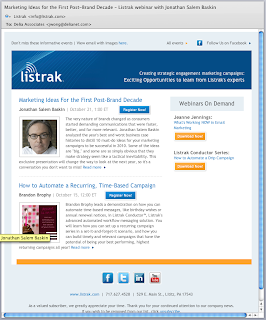
This is a somewhat new trend in e-mail marketing. Make sure you connect your e-mail campaign with your social media content to further gain your readers' trust as well as making your content more accessible. This means placing a facebook icon, twitter icon, and any other social media destination of which you have exposure on, and let the sharing begin.

While this approach also requires you to deploy an online copy of your e-mail on these social media (or on your own web) channels, it gives your readers another way to engage with your content and share it with their friends and colleagues.

As this example from listrak shows, the social media icons located at the bottom allows readers to share this e-mail content with everyone in their network who might not be a customer of listrak or a subscriber of this e-mail. This gives your subscribers a chance to spread the word for you if they found your content to be engaging.

4. CONTENT IS KING!
So far I've only been talking about how you can engage with technologies and how to understand the analytic. At the end of the day, your e-mail campaign is only as good as your content. Even if you do everything right, you won't get your readers to engage if your content is less than interesting. Try to avoid launching an e-mail campaign filled with PR, but develop content that are relevant and beneficial to your readers, and this will only come if you know your readers. Stop buying e-mail list simply because you don't know who they are and what interest them, but rather spend the time to build an opt-in list with people that you know, or at least know what may interest them. I'll talk about how to build an opt-in list tomorrow.

In the mean time, feel free to comment and add whatever you feel is also important in the comment area.

Friday, October 9, 2009

Ok, so we should do inbound marketing, but what about security?

Fresh from Inbound Marketing Summit in Boston, I am all pumped up and ready to start drafting a new social media strategy for my company and my clients. Afterall, the speakers like Brian Solis, Gary Vaynerchuk, Jason Falls, Chris Brogan, etc. (Complete list here - omissions not intentional) are just too awesome to ignore, it'll be a crime not to follow.

Several emails with clients and colleagues later, however, made me realize that as much as brands want to run out there to engage their customers and prospects, they are also concerned with data security. It is not just allowing their workers to go on facebook, linkedin and twitter at work, as brand marketers we must also educate them with all the security risks that they are exposing the brand to.

With that said, brand must set forth guidelines to draw boundaries on what their employees can and cannot say online. While verbal conversations are off-the-record, online social media communications are all recorded on the server, which means everything the employee says about the brand online are on-the-record.

Furthermore, just as I have blogged about how hackers picked up #ims09 hashtag on Twitter and spam the channel with adult materials, same risk holds true for the brand and their social media channels. Tests has been done by security experts that hackers can utilize these channels to create fake identity of the brand, connect to employees and send out fraudulent connection invites and email attachments that penetrates the corporate network.

So not only do brands need to allow their employees to utilize social media channels to listen to the customers and engage them, they must also be properly educated on how to properly spot security threats. Email attachments, links are among the most common method of hackers penetration. Always be alert of incoming network attack via these channels will keep your brand data safe and help you reach out to people the way social media was meant to do.

Wednesday, October 7, 2009

Inbound Marketing Summit Thoughts

I am going to interrupt my previous promise to write more about email marketing tools. But since I am currently at the Inbound Marketing Summit in Boston, I would like to share with all of you about what Inbound Marketing really is.

First of all, most current popular marketing channels such as TV ads, radio, banner / pop-up ads, even many Email marketing and social media ads are considered interrupted marketing. This form of marketing is considered interrupted method because it pause the user from their routine and force them to respond to your messages. While I see this form of marketing to continue, the newer form of Inbound Marketing is gaining a great deal of growth and expansion because it attracts users and prospects who are already looking for information about your message to come find you. And this form if marketing is about listening to what users are saying, locating where these conversations are taking place, and engage them with your creative content.

While the earlier form of marketing unique utilize market research to locate the best channel to distribute your message and measure penetration of your message by eyeballs and impressions. With inbound marketing, research on channel is replaced by locating where the listeners are, what they are saying about your industry and products, and distribute multiple messages by engaging in conversations and coming up with interesting content. Measures of success is engagement. Is about how many readers and users you can engage in conversations.

This is where social media channels comes in. Even the PR industry is shifting their focus on chasing after media channels to attractive them via viral content on social media. So the strategy for many companies is not on hiring PR firms that distribute news, but rather to hire content generation experts in their industries and engage in conversations that will bring in traffic and sales.

I will try to be more specific in subsequent posts and maybe locate some firms that can really help companies succeed in this form of marketing.

Friday, October 2, 2009

Start connecting your business on Twitter

Yes, I admit, this is not entirely original. Thousands if not millions of people have said this already. But the importance of outreaching to potential customers using social media can't be ignored. So here it is again.

Many consumer-oriented corporations and brands has already started their social media campaign on Twitter, Facebook, etc. But the concept remains largely non-touched by small- and middle-market. The core problem is perhaps not how to make connections, but what do you do with them?

For those of you who are still rather lost in the "Twitter for Business" concept, you should consider reading Twitter 101 for Business to get started. What for those of you who knows Twitter already, you have to focus on more than telling them what morning cup of coffee is making you sick.

Bottom-line: Content. A big list of followers may seem impressive, but are you really connecting with them with content? Sure, the 140 characters limit will limit what you can say, but it is this very dynamic that made Twitter so popular. Users can go through a short list of topics on their screen (much like reading news headlines on cnn.com or cnbc.com) and pick what they want to read about.

Then is the usefulness of the content. You have to think like your follower when you write. I've read so many twitter post that talk about what the business has accomplished and what client they've recently gotten. But that simply doesn't interest me as a follower anymore. I've much rather read about something insightful that can benefit me as a reader. Just remember, you're no longer "pushing" content like you used to on TV, radio, magazine and website. Social media involve "pulling" people to your content.